The namesake for this blog comes from Amory Lovins’s 1977 primer on sustainable energy use, Soft Energy Paths: Toward a Durable Peace.
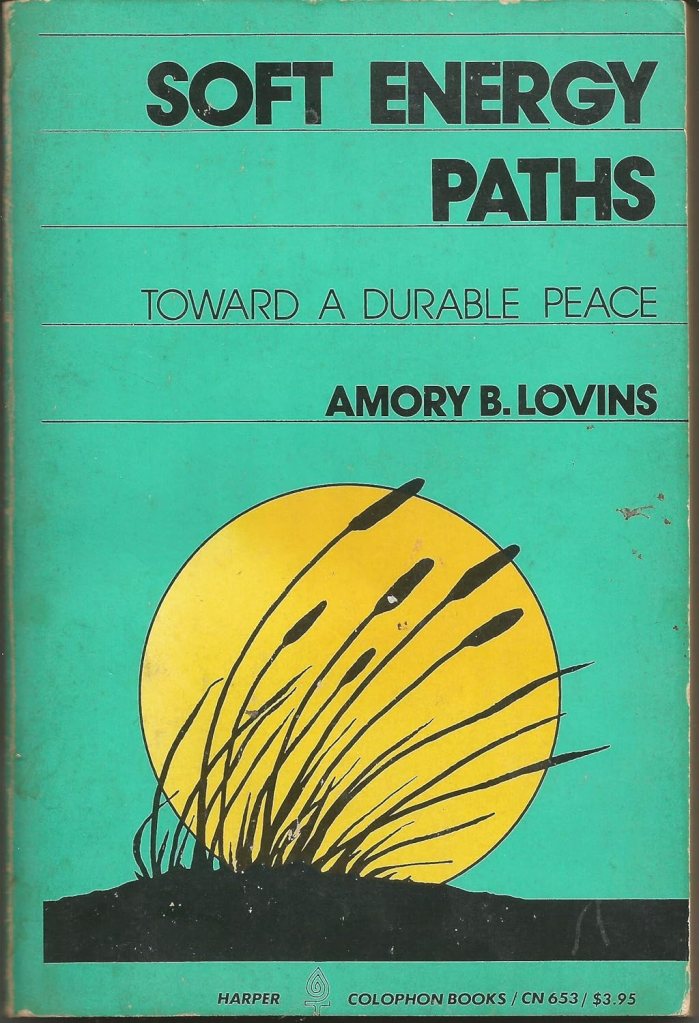
Great book. If you decide to pick up a copy, rest assured you really only have to read the first 60 pages to understand his thesis (the latter 2/3rds of the book describes–in detail–all the data that supports his arguments in the premiere part of the book). It’s fun to pop around in the supportive data in the back, but his thinking is particularly potent up front: essentially, a “Soft Energy Path” (as apposed to the “Hard Energy Paths” he describes we’re currently on) are ways to appropriately match energy production to the end-use need of that energy (seems simple, but the consequences are profound). I.E. If you wanted a drink of water, and you were near a tap, you wouldn’t sprint to the sink to get a glass of water, you’d mosey over. Or perhaps the better metaphor is: if you were thirsty, you only need fill a glass of water–maybe two–to drink, not a swimming pool full. Or as Lovins so eloquently puts it, our current energy economy is “like cutting butter with a chainsaw.”
The trick, to expose a common misperception, is to not conflate more energy with higher performance–an easy pill to swallow on the surface, but insidiously rampant otherwise in our culture at large. We see this fallacy played out more often in its inverse: the assumption that using less energy somehow leads to a loss in prosperity. But energy input (or lack thereof) is not directly linked to performance output. As Lovins notes, “insulating your roof does not mean freezing in the dark.” This energy≠performance dilemma is made especially plain when any degree of fragility of the energy source is considered. Using the same insulation analogy: if the heat (read: energy) source wains or is taken away, what delivers comfort? Not the quantity of energy input, but the quality of the environment’s ability to retain the heat (however limited) itself. End-use performance (thermal comfort, in this case) is delivered not solely by the application of energy in volume, but in fact the thoughtful capture of it by way of efficient use of a limited amount of it. Using less energy does not mean curtailing or sacrificing its function, but quite the opposite.
This scientific basis lays the foundation for a few “softer” (<– pun intended!) resolutions to emerge, having more consequence in the social and even spiritual dimensions of the human experience:
As a basis for mutual understanding, therefore, instead of leaving my world view to be guessed at (as most energy writers do), I shall make explicit a few of my underlying opinions not on every aspect of the whole universe of perceptions that must support any coherent view of our energy future, but at least on a few basic values. Attempting this is unusual and difficult but important. Briefly, then, I think that:
- we are more endangered by too much energy too soon than by too little too late, for we understand too little the wise use of power;
- we know next to nothing about the carefully designed natural systems and cycles on which we depend; we must therefore take care to preserve resilience and flexibility, and to design for large safety margins (whose importance we do not yet understand), recognizing the existence of human fallibility, malice, and irrationality (including our own) and of present trends that erode the earth’s carrying capacity;
- people are more important than goods; hence energy, technology, and economic activity are means, not ends, and their quantity is not a measure of welfare; hence economic rationality is a narrow and often defective test of the wisdom of broad social choices, and economic costs and prices, which depend largely on philosophical conventions, are neither revealed truth nor a meaningful test of rational or desirable behavior;
- though the potential for growth in the social, cultural, and spiritual spheres is unlimited, resource-crunching material growth is inherently limited (a consequence of the round-earth theory) and, in countries as affluent as the U.S., should be not merely stabilized but returned to sustainable levels at which the net marginal utility of economic activity (to borrow for a moment the economist’s abstractions) is clearly positive;
- since sustainability is more important than the momentary advantage of any generation or group, long-term discount rates should be zero or even slightly negative, reinforcing a frugal, though not penurious, ethic of husbanding;
- the “energy problem” should be not how to expand supplies to meet the postulated extrapolative needs of a dynamic economy, but rather how to accomplish social goals elegantly with a minimum of energy and effort, meanwhile taking care to preserve a social fabric that not only tolerates but encourages diverse values and lifestyles…
He goes on for another few points, but “energy, technology, and economic activity are means, not ends” is a real mic drop…Lovins presents a satisfying pragmatism that describes a world where things are fundamentally in right relationship to another. Thoughtful application of energy means a critical assessment of both its intended use and its means of production. It’s all linked together: the big and the small, individual action and communal consequence. If we began here every time we flip a light switch, put a kettle on to boil, or drive to the grocery store, well, I’d wager that nearly everything about our world as we know it would be different.
There was a great little film produced on Amory and his then-wife Hunter around the time of this book’s publication that’s well worth a watch if picking up the book itself is a bridge too far. This stuff gets me so jazzed, I hope it sparks a (~appropriately sized~) fire in you too!
 softpaths.blog
Leave a comment